

PODCAST WITH

Real conversations, practical wisdom, and encouragement for women embracing change at every stage.
Available on...





"Grief is not a problem to fix. It's an experience to be held and honored."
EPISODE 09.
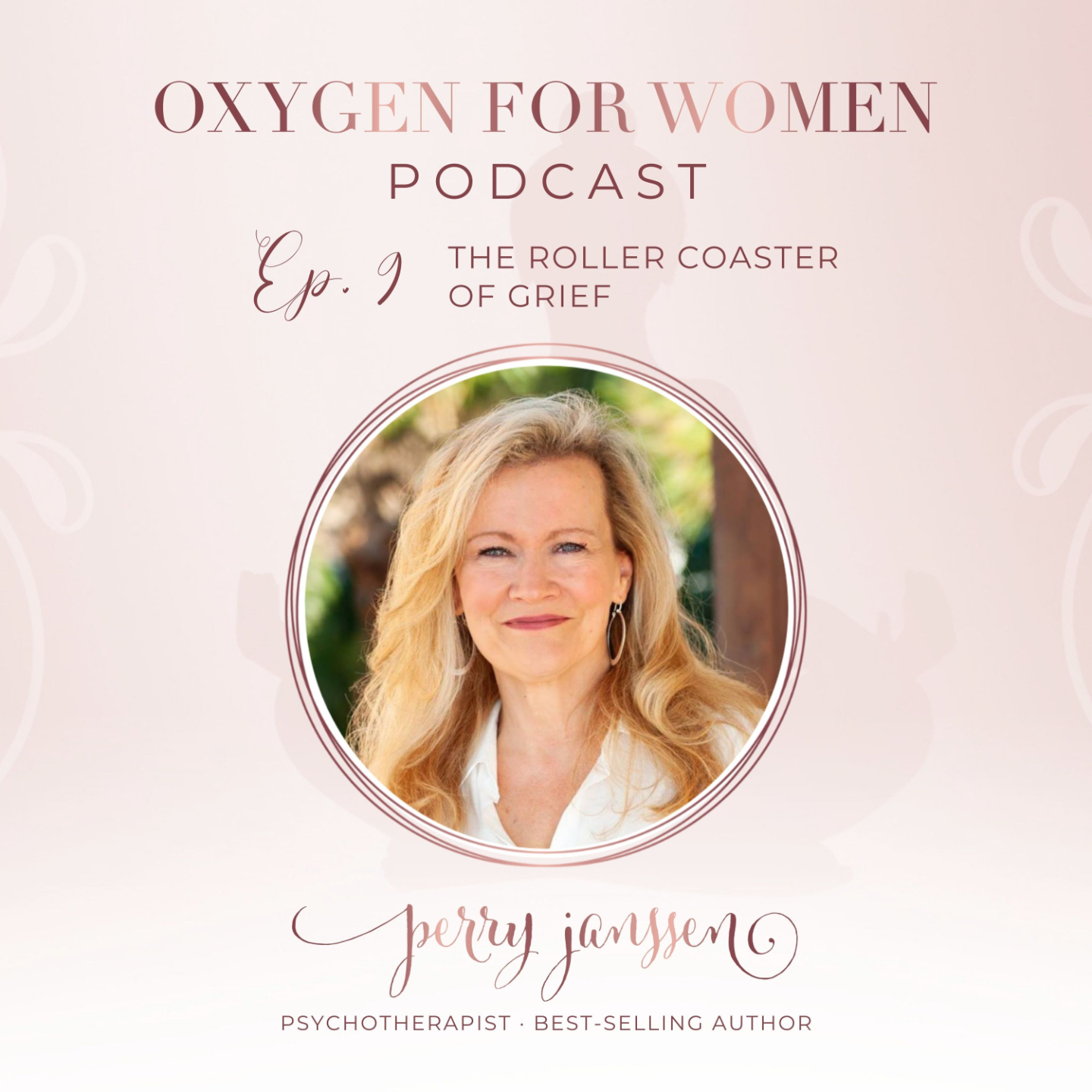
The Roller Coaster of Grief
Oxygen for Women Podcast
with Perry Janssen
Grief is not the neat stages we were taught to expect. It's waves, surprises, and moments you think you're okay and then suddenly you're not.
In this deeply personal episode, Perry shares her family's recent loss and decades of experience working with grief. She explores what grief actually feels like, why it doesn't move in straight lines, and how we learn to live with it without rushing ourselves out of it.
If you've ever felt confused by your grief or wondered why it doesn't follow a predictable path, this conversation is for you.
Personal Context
Perry's family is currently dealing with loss—feeling brokenhearted, gutted, and on a roller coaster. She calls herself "an Olympic champion at dealing with loss" and knows it intimately. This episode comes from lived experience.
Types of Loss
All kinds of loss create grief:
- Death
- Divorce
- Losing your job
- Friendships ending
The common component: grief
The Reality of Grief
Grief Is Not Linear
Grief is more like a tornado. One moment the sky feels calm (you laugh, work, and make dinner), then suddenly a wave hits: anger, sadness, numbness, maybe relief, guilt, love, and deep longing. You think, "I thought I was doing better."
Nothing is wrong with you. This is how grief moves.
The Problem with the Five Stages
Elisabeth Kübler-Ross (who worked with AIDS patients) came up with the five stages of grief. While her work was amazing, the stages were never meant to be a rigid roadmap, though many people were taught to believe they were, which can be crazy-making and shaming.
What Perry sees after decades of work:
- Grief circles back on itself
- You can feel peaceful in the morning and deeply raw by afternoon
- You can feel gratitude one day and resentment/anger/irritability the next
- You can feel strong and then suddenly fragile and vulnerable
Grief is a nervous system and spirit experience.
Your body is adjusting to an absence, a change, a rupture in the fabric of your life.
Perry appreciates the Jewish tradition of ripping the collar and wearing black or white in some cultures (visible signals to let others know you're going through this time).
Your body doesn't process loss in straight lines. It processes in waves. Sometimes gentle, sometimes they knock the wind out of you. None of that means you're failing at healing.
Stop Asking, "Are You Okay?"
Perry asks people to please stop asking grieving people, "Are you okay?" While well-intended, it quietly carries pressure, suggesting:
- There's a right answer
- They should be okay by now
Many grieving people feel they have to protect others from their pain. When asked, "How are you?" with hopeful eyes, they often say, "I'm fine," even when they're not.
What grieving people need isn't pressure to be okay—they need permission to be real.
Instead of "Are you okay?" try:
- "I'm here with you."
- "You can be exactly where you are today."
- "I'm right here without judgment."
Grief softens when it feels witnessed, not evaluated.
Grief Doesn't Disappear
One of the hardest truths: grief doesn't disappear. Many people ask, "When will this be over? When will I be through this? When will I get rid of this?"
What actually happens is more human, more compassionate: you learn to live with it.
The Stone Metaphor:
Perry's client sent her an image of grief as a large stone in someone's pocket:
- At first, the stone feels impossible to hold. So heavy, consuming your energy, creating immense fatigue, shallow breath
- Over time, something shifts. Not because the stone grows smaller, but because you grow stronger around it
- You build new muscles, find ways to rest while carrying it, learn where to place it down for a while
- Sometimes you discover the stone carries memories, love, and meaning. Not just pain
Grief is love that no longer has the place where you thought it went. Learning to carry that love differently is part of the journey.
The Complexity of Grief
Grief contains many emotions, not just sadness:
- Anger
- Relief
- Guilt for laughing or enjoying something again
- Feeling gutted
- Extreme fatigue and exhaustion
All of these feelings belong.
Grief is not one pure emotion. It's complex, especially for women taught to be composed, nurturing, and emotionally controlled. Grief can feel messy and confusing.
Messy doesn't mean broken. Messy means human.
Your nervous system and spirit are trying to reorganize a world that no longer looks the same:
- Some days you feel numb. That's not avoidance; it's protection, a break
- Some days you feel overwhelmed. That's not weakness; it's your heart adjusting to a different reality
Perry's "Death Year"
Years ago, Perry's dad and a close friend died in the same year. She thought she would drown in it. But she did something counterintuitive:
She decided to surrender to it.
"I am going to feel what I feel. I'm going to let it run through me, and I'm going to be with it as much as I can."
She learned grief has a purpose: it kept her heart open. It kept cracking open more and more instead of becoming defended and armored. She wanted to shut down, harden up, and brace against the pain. But she allowed herself time and space to truly go into it.
It wasn't smooth, pretty, or easy. She still carries it differently. "It shucked my oyster."
She realized: Grief is worth the being that you lost because it reminds you that you have loved so deeply, that you have deep feelings.
Gentle Ways to Move With Grief
Instead of trying to get over grief, here are ways to move with it:
- Let the feelings come (in small moments)
- Work softly with your breath. Don't force deep breathwork
- Smoothly, softly allow breath into the parts that are aching and hurting
- You don't have to dive into the deepest parts all at once
- Even a few breaths of acknowledging what's there matter
- Speak to your body
- Your body carries grief physically: pain, tightness in chest, heaviness, fatigue
- Place a hand on your chest (or use a pillow like Perry did during her "death year")
- Bring warmth to your chest (it's an acupressure point)
- Reassure yourself: "I'm here. I am here. I'm right here with you."
- Create small rituals
- Light a candle (Perry's family keeps a tall candle lit)
- Write a letter
- Plant flowers or a tree
- Sit with the memory
- Grief needs expression, not suppression
- Talk to the person/being you lost. Keep talking to them
- Allow joy without guilt
- Moments of laughter don't erase love. They coexist with it
- If you've lost someone, they likely want you to live, not just be gutted
- Stop measuring your timeline
- There's no expiration date on grief
- It's pervasive through a lifetime
- Drop the word "still" from "I'm still dealing with..."
- You feel what you feel, and you heal when you heal. There is no timeline.
How Grief Changes You
Grief changes people, not always in visible ways:
- Sometimes it softens you, opens your heart
- Sometimes it makes you fiercer about protecting what matters
- Sometimes it strips away expectation and reveals what is real
Grief is not just an ending—it's a reorganization.
You are not meant to return to who you were before the loss. You're allowed to let it expand you, be shaped by love and memory and the resilience it takes to carry it.
Message to Those Walking Through Grief
If you're walking through grief right now:
- You're not behind
- You're not doing it wrong
- You don't have to rush yourself into healing
- You don't have to be fine for people
Grief is not a problem to fix—it's an experience to be held and honored
About Oxygen for Women
At Oxygen for Women, we talk about reclaiming ourselves after life changes us through stress, loss, trauma, and expectations that tell us to stay strong no matter what.
Healing doesn't begin by pushing grief away. It begins by making space for all the parts of you that are learning how to carry the stone and still keep living. It doesn't heal through rejection and defensiveness.
Powerful Quotes
"Grief is not linear. It's not predictable, and it's definitely not something you finish."
"Nothing is wrong with you. This is how grief moves."
"Your body doesn't process loss in straight lines. It processes in waves."
"What grieving people need isn't pressure to be okay—they need permission to be real."
"Grief softens when it feels witnessed, not evaluated."
"The stone feels impossible to hold at first, but over time you grow stronger around it—not because the stone grows smaller, but because you grow stronger."
"Grief is love that no longer has the place where you thought it went. Learning to carry that love differently is part of the journey."
"Messy doesn't mean broken. Messy means human."
"Grief has a purpose. It kept my heart open. It kept cracking open more and more instead of becoming defended and armored."
"Grief is worth the being that you lost because it reminds you that you have loved so deeply."
"You feel what you feel, and you heal when you heal. There is no timeline."
"You are not meant to return to who you were before the loss. You're allowed to let it expand you."
"Grief is not a problem to fix. It's an experience to be held and honored."
Connect & Share
Stay connected through:
- The Oxygen for Women podcast
- The Oxygen for Women community
- Personal Growth for Women (free Facebook group)
If you know someone going through grief, share this episode; it may help them feel less alone.
Closing
Take a breath. Be gentle with yourself. Wherever you are today, calm or stormy, Perry is glad you're here.
Oxygen for Women: A space for women who have been strong for so long and are ready to come back to themselves with honesty, compassion, and breath.
DOWNLOAD THE EPISODE TRANSCRIPTSubscribe for weekly episodes
and get it delivered right into your inbox!
Oxygen for Women is your weekly dose of inspiration and actionable strategies designed for the modern woman.

Download the Free Guide & Somatic Practice
Let’s give you the education you needed the most and didn’t get. Here is the #1 proven practice for navigating burnout, stress patterns, and feeling stuck to empower you and strengthen your resilience, peace, and joy of life.
