
PODCAST WITH

Real conversations, practical wisdom, and encouragement for women embracing change at every stage.
Available on...





"Having needs does not make you difficult.
Suppressing them is what you were taught to do."
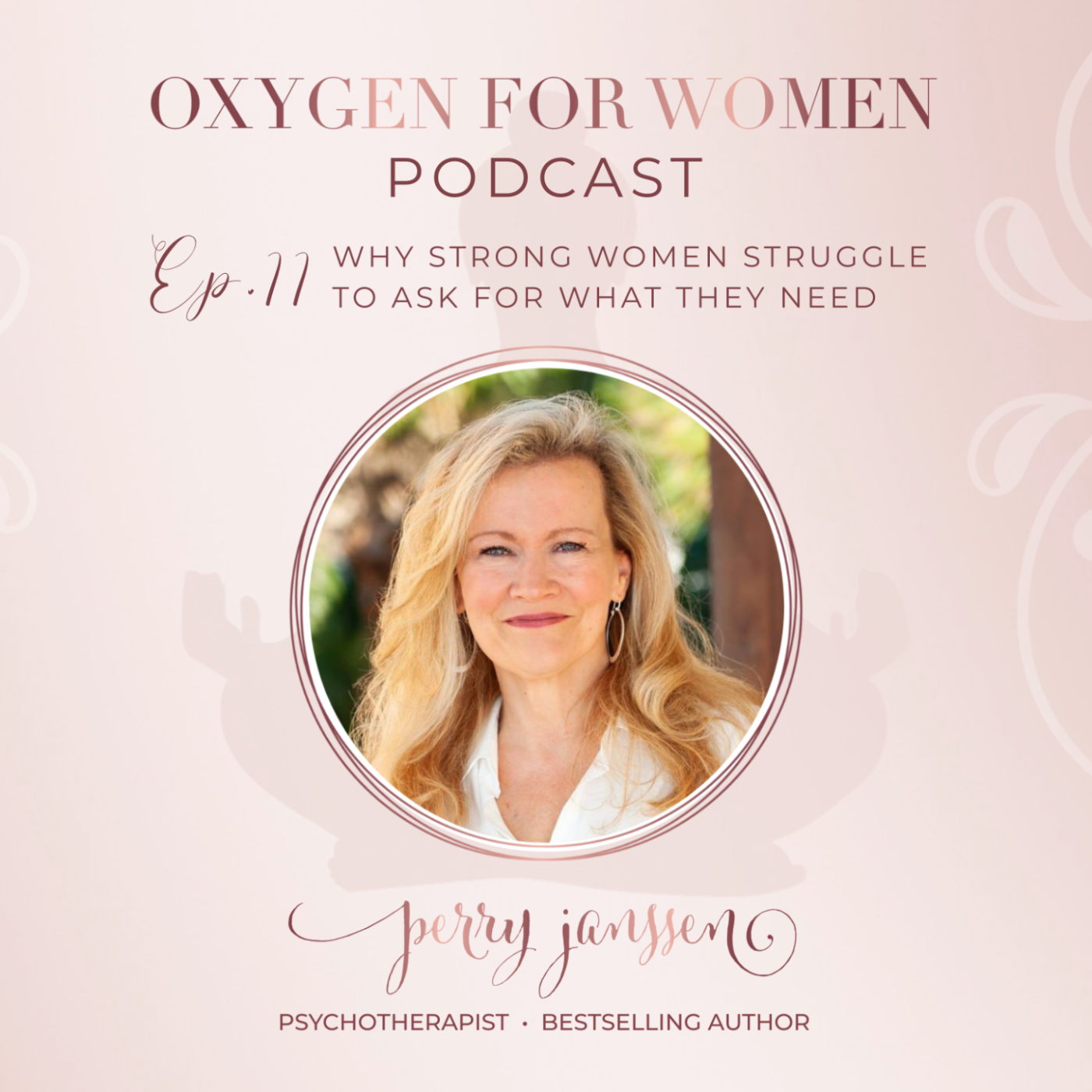
EPISODE 11.
Why Strong Women Struggle to Ask for What They Need
Oxygen for Women Podcast
with Perry Janssen
Asking for what you need is not hard because something is wrong with you.
It is hard because you were conditioned to put your needs last.
In this episode, Perry explores why so many women struggle to express their needs, say no, or speak honestly without guilt. She weaves together psychology, history, culture, and nervous system science to help you understand that this difficulty is not a personal failure — it’s a learned adaptation.
If you’ve ever held back what you really needed to say…
If you’ve ever said “I’m fine” while feeling the opposite…
If you’ve ever prioritized others and felt drained or resentful afterward…
This conversation is for you.
The Paradox of Strong Women
One of the most common patterns Perry sees in her work is this:
The women who appear strongest on the outside often struggle the most internally.
They are:
Highly capable
Responsible
Emotionally aware
Deeply caring about the people in their lives
They manage families, careers, relationships, and responsibilities with remarkable competence.
Yet privately many of these women feel something very different.
They may feel:
Stretched thin
Emotionally invisible
Responsible for everyone else's well-being
Unsure how to ask for support
The paradox is this:
The more capable a woman is, the more people rely on her.
And the more people rely on her, the harder it becomes to step out of that role.
The Cultural Conditioning Behind It
To understand why this happens, we must look beyond individual psychology.
For much of history, women were not encouraged to have a strong public voice.
Women were once denied the ability to:
Vote
Own property
Control finances
Make independent choices about their lives
Even as laws have changed, cultural conditioning remains deeply embedded.
Women have long been rewarded for being:
Pleasant
Helpful
Agreeable
Emotionally accommodating
And when women spoke directly or asserted their needs, they were often labeled:
Difficult
Emotional
Too much
Selfish
Over time, many women internalized an important survival message:
It is safer to be liked than to be honest.
And safer to maintain harmony than to disrupt a relationship.
Emotional Caretaking as a Role
From a young age, many girls are socialized to become emotional caretakers.
They are encouraged to:
Notice how others feel
Maintain harmony in relationships
Be thoughtful and accommodating
Take responsibility for emotional tension
These qualities are not negative.
In fact, they are beautiful expressions of empathy and care.
But when these qualities come with an unspoken rule, the cost becomes heavy.
That rule often sounds like this:
Everyone else's feelings matter more than yours.
As a result, many women become incredibly skilled at reading emotional environments.
They anticipate needs.
They smooth conflict.
They stabilize relationships.
But along the way, something important is often lost:
They are rarely taught how to care for their own emotional world.
The Fear of Disappointing Others
One of the deepest reasons women struggle to say no is the fear of disappointing others.
For many women, belonging and approval have historically been tied to how accommodating they are.
When a woman begins to say:
“I can’t do that.”
“That doesn’t work for me.”
“I need something different.”
Something inside her may react immediately.
She may feel:
Guilt
Selfishness
Fear of upsetting someone
Fear of losing connection
Even when the request she is making is completely reasonable.
This internal reaction is not a moral failure.
It is often a conditioned response built over years of reinforcement.
Invisible Labor and Emotional Responsibility
Many women also carry enormous amounts of invisible labor.
They manage:
Family schedules
Emotional tensions
Household responsibilities
Workplace dynamics
Relationships across multiple areas of life
They remember the birthdays.
They anticipate problems before they happen.
They hold emotional space for others.
This type of labor is rarely recognized as work, yet it requires constant awareness and emotional energy.
Over time, women may become so focused on caring for everyone else that they lose touch with something essential.
Their own needs.
Many women Perry works with can easily describe what everyone else in their lives needs.
But when asked what they need, they hesitate.
When the Body Begins to Speak
As a psychotherapist, Perry often sees how the body begins to communicate when emotional needs have been suppressed for too long.
The body may respond through:
Burnout
Exhaustion
Chronic stress
Anxiety
Digestive disorders such as IBS
Emotional overwhelm
These responses are not signs of weakness.
They are signals.
The body is communicating something important:
This is too much.
Many women have been carrying emotional and relational responsibility for years without adequate support.
Eventually, something inside the system begins to push back — not as failure, but as a call for balance.
Relearning How to Have a Voice
Learning to speak up as an adult can feel surprisingly unfamiliar.
Simple statements like:
“I need help.”
“I need time for myself.”
“I feel differently about this.”
can feel awkward or uncomfortable at first.
But healthy relationships require something essential:
Honesty
Boundaries
The presence of a whole person
Without these, resentment quietly builds and exhaustion grows.
Reclaiming your voice is not about becoming aggressive.
It is about allowing your needs, your feelings, and your truth to exist alongside everyone else’s.
A Cultural Shift Is Happening
Across the world, more women are beginning to question the expectations they were raised with.
They are noticing the cost of chronic self-sacrifice.
The cost to:
Their health
Their creativity
Their relationships
Their sense of joy
Many women are beginning to ask a powerful question:
What would my life look like if my needs mattered too?
This question represents something larger than personal change.
It is part of a broader cultural awakening.
A Gentle Invitation
If this conversation resonates with you, you are not alone.
Many strong, capable women have spent years holding everything together while quietly putting themselves last.
Learning to reconnect with your voice, your needs, and your boundaries does not happen overnight.
It happens gradually.
Through awareness.
Through support.
Through practice.
Inside Oxygen for Women, Perry guides women through this process of returning to themselves.
Together they begin to:
Reconnect with their voice
Understand the conditioning that shaped them
Build healthier boundaries
Restore balance between giving and receiving
Because the world does not need women who are exhausted from carrying everything alone.
The world needs women who are able to live fully as the woman they truly are.
To learn more about Oxygen for Women, visit:
oxygenforwomen.com
Powerful Quotes
“Strong women often struggle the most to ask for what they need because they’ve spent so long carrying everything for everyone else.”
“The more capable a woman is, the more people rely on her — and the harder it becomes to step out of that role.”
“Many women are taught how to care for everyone else's emotional world, but rarely how to care for their own.”
“The body often speaks when the voice has been silenced for too long.”
“Reclaiming your voice is not about becoming aggressive. It is about allowing your needs to exist alongside everyone else's.”
Connect & Share
Stay connected through:
- The Oxygen for Women podcast
- The Oxygen for Women community
- Personal Growth for Women (free Facebook group)
If you know someone going through grief, share this episode; it may help them feel less alone.
Closing
If this episode resonated with you, share it with a woman in your life who may need to hear it.
Take a breath.
Wherever you are today — strong, exhausted, steady, or uncertain — you are not alone.
Oxygen for Women: A space for women who have been strong for so long and are ready to come back to themselves with honesty, compassion, and breath.
DOWNLOAD THE EPISODE TRANSCRIPTSubscribe for weekly episodes
and get it delivered right into your inbox!
Oxygen for Women is your weekly dose of inspiration and actionable strategies designed for the modern woman.

Download the Free Guide & Somatic Practice
Let’s give you the education you needed the most and didn’t get. Here is the #1 proven practice for navigating burnout, stress patterns, and feeling stuck to empower you and strengthen your resilience, peace, and joy of life.
